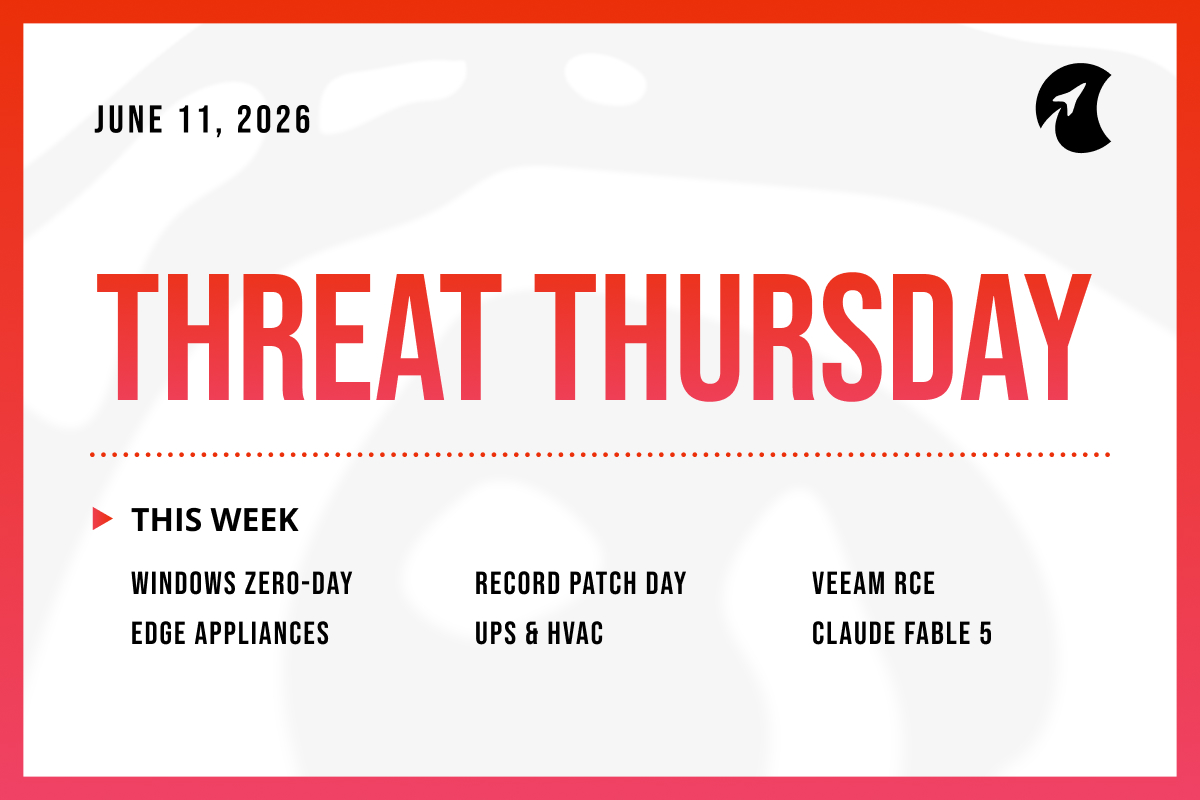
Welcome to Threat Thursday, Galactic's weekly threat intelligence roundup.
This week's stories share one theme: the gap between a vulnerability becoming public and a working exploit existing is collapsing toward hours, and the coordinated disclosure process meant to give defenders a head start is under real strain. You can see it in an unpatched Windows zero-day dumped in public, in Microsoft's record-breaking patch load, and in the new AI models that can turn a disclosed flaw into an exploit in under a day.
Each story breaks down what happened, what it could mean for your organization, and what to do about it. Whether you're overseeing risk, running security operations, or just trying to stay current, this update is built to help you keep your organization cyber safe.
This Cycle's Stories
1. Public Exploit for an Unpatched Windows Defender Flaw: RoguePlanet
On June 10, a researcher who goes by Chaotic Eclipse published working attack code for RoguePlanet, a flaw in Microsoft Defender (the antivirus built into Windows) that has no fix yet. It is a "race condition," a type of timing bug. A program often checks that something is safe and then, a split second later, acts on it. In a race condition, the attacker exploits that tiny gap: they let the software approve a harmless file, then swap in a malicious one before the software actually uses it, so it ends up running the bad version it never checked. The payoff in this case is SYSTEM-level access, the highest level of control on a Windows machine. The researcher confirmed it on fully updated Windows 10 and 11, so being current on patches does not close it (Windows Server is not affected by the current technique). Importantly, this is a local flaw: it does not break in from outside on its own, but it lets an attacker who already has a foothold become an administrator with high level access and privileges. It is the latest in a run of Windows vulnerabilities the same researcher has dumped publicly after a falling-out with Microsoft, which has called the dumps irresponsible while it works on fixes.
Potential impact: The headline most people will take from this is “patched Windows is still vulnerable,” and that is true, but the bigger point is where the risk actually sits. RoguePlanet is a privilege-escalation tool, not a break-in tool, so its real danger is in the second act of an attack. After an intruder has access via a phishing click or stolen password, this is what turns it into full control, and full control of one machine is the usual launch pad for spreading across a network. The harder problem is the disclosure pattern around it. When a researcher releases working attack code before a vendor has a fix, every defender is exposed at once, with no patch to deploy. This is roughly the sixth such drop from the same person. It is a live example of what happens when the give-and-take between researchers and vendors breaks down: the people who get hurt are the customers in the middle.
What to do: With no patch available, defenders should tighten the basics that contain an intruder’s movement. Make sure endpoint protection is secured and updated so it can flag the public exploit, limit which users can run software and mount disk images on their machines (the current exploit depends on the latter), and review activity by local administrator accounts. Watch Microsoft’s security update guide for an out-of-band fix and be ready to deploy it quickly. Most of all, keep the first stage of an attack from succeeding, because this flaw only matters to an attacker who already got in.
Source: Security Affairs
2. Microsoft Patches a Record 206 Flaws, Including Three Public Zero-Days
Microsoft’s monthly “Patch Tuesday” update for June 2026 was its largest ever. According to The Hacker News, it fixed 206 vulnerabilities, 39 rated Critical, with three made public before the patches arrived. Three of the most serious are rated 9.8 out of 10 on severity and share a dangerous trait: an attacker needs no password and no help from a user, just the ability to send the right network traffic. They affect the Windows kernel (CVE-2026-45657), the web-traffic component HTTP.sys (CVE-2026-47291), and the Windows DHCP client (CVE-2026-44815). Microsoft and outside analysts attribute the record volume to AI tools now finding flaws faster than humans ever could, noting it has already shipped more fixes this year than in all of 2018.
Potential impact: Two things stand out. First, the three unauthenticated 9.8 flaws are the kind that can spread on their own, because anything reachable over the network with no login is the dream scenario for an attacker. Organizations should rank these above the rest of the pile, especially on servers and anything exposed to the internet. Second, the record size of this release is notable, and it is not likely to be a one-off. If AI-assisted discovery keeps producing months like this, the limiting factor stops being whether a vendor can find and fix bugs and becomes whether customers can test and deploy that many patches without breaking things. As one researcher put it, a flood of patches this large raises real questions about what quality issues might be hiding in it. Patch volume is becoming an operations problem, not just a security one.
What to do: Affected organizations should deploy the June 2026 updates promptly and lead with the three unauthenticated remote code execution flaws on internet-facing systems and servers. Because reported CVE counts varied between outlets, scope the exact list against Microsoft’s official release notes rather than a news summary. Where Windows web servers (IIS) are in use, apply the new setting Microsoft added to limit request headers, which blocks a separate denial-of-service technique. For organizations on a staged rollout, move the highest-severity items to the front of the queue.
Source: The Hacker News
3. A Veeam Backup Flaw Lets an Ordinary User Take Over the Backup Server (CVE-2026-44963)
Veeam, one of the most widely used backup products in business IT, patched a critical flaw that lets an attacker run code on the backup server itself (CVE-2026-44963, rated 9.4). The important note is that it only requires an authenticated “domain user,” meaning any normal employee account, not an administrator. Every version 12 release up to 12.3.2.4465 is affected, the fix is in 12.3.2.4854, and the version 13 line is not vulnerable. The flaw was reported responsibly by the security firm watchTowr, and Veeam notes that past vulnerabilities in this product have been used in real ransomware attacks.
Potential impact: Backups are the one system a ransomware group most wants to destroy, because working backups are what let a victim recover without paying. That is what makes this flaw worse than its score suggests: an attacker does not need to compromise an administrator, just any single employee account, and from there they can reach the server that holds your last line of defense. The pattern worth watching is that attackers now go after backup infrastructure early in an attack, before they even trigger the ransomware, precisely so the victim has no fallback. A flaw that hands over the backup server to a low-level account is a gift to that playbook. This is a patch-now item, not a patch-at-the-next-window item.
What to do: Organizations running Veeam Backup & Replication should upgrade to 12.3.2.4854 right away. If an immediate upgrade is not possible, restrict which accounts and network segments can reach the backup server, and confirm that backups are immutable (cannot be altered or deleted) and have been tested recently. Review the backup server’s logs for access from ordinary user accounts that have no reason to touch it.
Source: The Hacker News
4. Critical, Pre-Login Flaws in Fortinet and Ivanti Security Appliances
Two makers of network security appliances, Fortinet and Ivanti, released critical patches on the same day. Fortinet’s most serious flaw is in FortiSandbox, an appliance that inspects suspicious files for malware (CVE-2026-25089, rated 9.8). It allows a remote attacker with no login to send and run malicious commands on the device. Ivanti’s is higher-rated: its Sentry product has a flaw rated a maximum 10.0 (CVE-2026-10520) that runs commands as “root” (the highest level of control), plus a second flaw (9.9) that lets an attacker create their own administrator account. Ivanti’s mobile-device-management product, Endpoint Manager Mobile, also received two high-severity fixes. Both companies say there is no evidence of exploitation yet, and both have published fixed versions.
Potential impact: The reassuring line in these advisories is “no known exploitation.” The uncomfortable context is that Fortinet and Ivanti edge devices have been among the most reliably attacked products of the past few years, because they sit at the boundary of the network and a single compromised appliance often opens the door to everything behind it. Where the standard advice falls short is in treating “no known exploitation” as breathing room. For this class of device, the gap between a patch release and a working public exploit has repeatedly been measured in days, and attackers scan the entire internet for the ones still unpatched. The right way to read these advisories is as a short head start, not an all-clear.
What to do: Affected organizations should patch FortiSandbox and Ivanti Sentry and Endpoint Manager Mobile to the fixed versions this week, prioritizing any device whose management interface is reachable from the internet. These interfaces should not be internet-facing at all; place them behind a VPN or restrict them to trusted internal addresses. On Ivanti Sentry specifically, review the list of administrator accounts for any that were not created by your team, since one of the flaws allows an attacker to add their own.
Source: SecurityWeek
5. The Power and Cooling That Keep Data Centers Online Have Critical Flaws
Researchers at the security firm Claroty found critical flaws in two kinds of equipment that quietly keep data centers running: the battery backups (UPS) that keep machines on during a power cut, and the controllers that manage cooling (HVAC). In Vertiv’s Liebert UPS network cards, they chained together a login bypass (CVE-2025-46412) and a memory flaw (CVE-2025-41426), both rated 9.8, to take control of the UPS and issue a command that cuts power to whatever it feeds, up to a whole facility. Separately, flaws in Trane’s Tracer SC+ building controller let an unauthenticated attacker take full control of the cooling system from outside. Claroty reported both privately, and Vertiv and Trane have released fixes.
Potential impact: Most organizations file power and cooling under “facilities,” not “cybersecurity,” and that blind spot is the whole point of this research. A server room that loses power or cooling does not degrade gracefully; servers shut down hard, hardware can be physically damaged by heat, and the downtime can run into serious financial losses. These UPS and HVAC controllers are full computers sitting on a network, often installed once and rarely touched again, which makes them ideal long-lived targets. The broader lesson is that the security perimeter now includes the systems that keep the lights on and the room cool, and an attacker who cannot breach your servers directly may simply switch off the things they depend on. For any organization that runs its own server room or rents space in a colocation facility, it’s important to ask who is patching that equipment.
What to do: Organizations should inventory UPS network cards and building or HVAC controllers across their sites and any hosting space they use and apply the vendor firmware updates (Vertiv lists specific versions for its Liebert RDU101 and IS-UNITY cards). Critically, these management interfaces should never be reachable from the public internet. Put them on a separate, segmented network behind a VPN. Treat this category of operational equipment as part of the security program, with a named owner responsible for keeping it patched.
Source: SecurityWeek
6. Anthropic’s New AI Models Make the Gap Between a Flaw and an Exploit Even Shorter
On June 9, the AI company Anthropic released Claude Fable 5, its most capable model, and shipped it as two products separated by safety controls. The public Fable 5 redirects requests involving offensive cybersecurity to a weaker model (Opus 4.8), while the unrestricted twin, Mythos 5, keeps those capabilities available to vetted security professionals. The reason for the split is what the model can do: in earlier testing it found and exploited previously unknown flaws across every major operating system and browser when a human directed it. The same capability has a defensive side, with partner organizations using it to find more than 10,000 high- or critical-severity flaws in important software. Anthropic also introduced a 30-day data-retention requirement for traffic through these models, which it says is for safety monitoring, not training.
Potential impact: For defenders, the number that matters is buried in the testing: starting with only the public flaw and its official patch, the model built a working attack in under a day. That is the practical meaning of “the patch window is closing.” The old assumption, that organizations have weeks between a flaw becoming public and a usable exploit existing, is the assumption this technology breaks. There is a genuine upside, since the same capability is helping vendors find and fix more flaws than ever, but it comes with a silver lining that ties directly to the rest of this week’s news: open-source maintainers have asked Anthropic to slow its flow of bug reports because they cannot write patches fast enough. Discovery has become cheap and fast; fixing has not. The bottleneck, and the danger, now sits in the days between a public disclosure and a deployed patch, which is exactly where attackers operate.
What to do: Organizations should plan for a shorter clock and assume a high-severity flaw can become a working exploit within hours of disclosure rather than weeks. The practical moves are to prioritize automatic updates on anything facing the internet, and to treat software updates that fix known flaws as urgent work rather than routine maintenance. Multi-factor authentication and thorough logging remain the baseline, so that a single missed patch is not the only thing standing between an attacker and the network. Teams with strict rules about where their data can go should factor the new 30-day retention requirement into any decision to route sensitive information through these models.
Source: The Hacker News
The Big Picture
Two forces run through this week’s stories, and they pull in the same direction. The first is speed. Anthropic’s Fable 5 launch put hard numbers on something defenders have felt coming: an AI model built a working exploit from a public flaw and its patch in under a day. Then we see on top of this Microsoft’s record-breaking 206 fixes in this month’s Patch Tuesday. The comfortable assumption that a newly disclosed flaw takes weeks to weaponize is gone. That is why so much of this cycle is patch-now rather than patch-soon, from Veeam’s backup server to Fortinet and Ivanti’s edge appliances to the Vertiv and Trane gear running data-center power and cooling.
The second force is the strain on coordinated disclosure, the quiet agreement that researchers tell vendors first, vendors ship a fix, and customers get protected before the exploit goes public. When it works, you get the head start that Fortinet, Ivanti, Veeam, Vertiv, and Trane all gave their customers this week: a patch in hand before any attacks. When it breaks, you get RoguePlanet, a working Windows exploit dumped in public with no fix available, the latest casualty of a researcher’s feud with Microsoft. And the strain is showing on the defensive side too, where maintainers are asking AI labs to slow down because they cannot patch as fast as the bugs arrive. The takeaway is not to panic but to shorten your own clock: patch faster, automate updates where you safely can, and treat the stretch between disclosure and a deployed patch as the most dangerous part of the cycle, because that is exactly where it is getting harder to stay ahead.
Make sure to check back here each week for another Threat Thursday update. See you then!